

6 Key Material Handling Trends to Watch in 2026
by Christopher McCain, Manager, OEM Accounts
From footprint to maintenance to power, market trends have an impact on material handling equipment like Class III pallet jacks. To keep up, batteries for pallet jacks and other equipment must meet new requirements.
What's changing in material handling industries?
The material handling industry is evolving rapidly as warehouses, distributors, and delivery operations respond to changing customer expectations and increasingly complex logistics networks.
From tighter delivery environments to workforce challenges, companies need equipment and power solutions that deliver efficiency, reliability, and simplicity.
These factors apply most to Class 3 pallet jacks. They remain critical tools in grocery retail, beverage distribution, food preparation, and more. As operations adapt to new logistical realities, several trends are emerging that are shaping the way businesses approach material handling.
Batteries for pallet jacks and other material handling equipment
Class 3 pallet jacks and other equipment must meet the changing requirements emerging from key market trends. These trends include efficiency, reliability, and simplicity.
Battery technologies specifically designed for today’s material handling environments are critical for reliable operation.
1. Operating in Tighter Spaces
A top trend is the need for equipment to operate in smaller and more constrained environments. Delivery drivers and warehouse operators are increasingly navigating tight loading docks, urban delivery zones, and confined truck spaces.
Manufacturers have recognized this shift and are designing pallet jacks with smaller footprints and tighter turning radiuses. In many cases, shaving a few inches off a pallet jack can improve maneuverability. This is especially true when it is stored or used on semi-trucks.
For companies managing high-frequency deliveries, these small design improvements can make a meaningful difference in productivity. Equipment that can move smoothly through tight aisles or small truck spaces helps drivers finish deliveries faster and with less strain.
2. Class III Pallet Jacks on Delivery Trucks
Adoption of on-truck material handling equipment is growing. Many alcohol, soda, and other beverage distributors now equip their delivery trucks with Class III pallet jacks.
On-truck equipment must be reliable and durable to survive the demands of daily deliveries. Weight is also an important consideration.
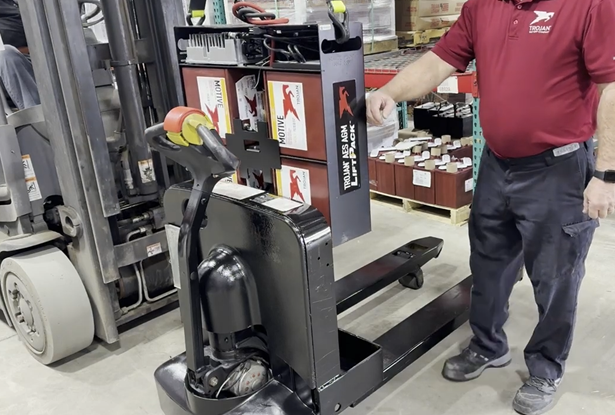
For these applications, pallet jack configurations paired with sealed lead acid batteries provide consistent performance. An example is Trojan’s AES AGM LiftPack™ Battery Pack. The lightweight advanced AGM batteries in this Class 3 pallet jack battery pack handle vibration and shock without spills.
3. Growing Grocery and Retail Demand
Large grocery chains and retailers are heavily reliant on Class III pallet jacks. In most cases, these are still the most efficient methods of moving product from delivery trucks to shelves.
In high-volume scenarios, reliable power is critical to ensure uptime. Equipment that runs out of power or is only chargeable on a strict schedule is inadequate.
Power deficits can quickly disrupt workflows, delay stocking, and create operational bottlenecks. For retailers focused on maintaining lean operations and fast product turnover, dependable power is essential to keeping material moving without interruption.
Pallet jack batteries with long cycle life and opportunity charging capabilities reduce downtime significantly.
Class III pallet jacks and other equipment must meet the changing requirements emerging from key market trends. These trends include efficiency, reliability, and simplicity."
6 Key Material Handling Trends to Watch in 20264. Safety and Durability for Specialized Environments
In certain industries, particularly food preparation and processing, equipment must meet strict safety and sanitation standards. These environments frequently involve exposure to water and wash-down procedures that can damage sensitive electrical components.
For operations like these, charging equipment should meet high ingress protection ratings.
5. Shift Toward Low-Maintenance Power Solutions
Workforce dynamics have changed significantly in recent years. Many operations no longer employ mechanical staff to perform routine battery tasks like watering and equalization.
Some operations skip maintenance procedures altogether to meet productivity demands. The result is shorter battery life and reduced equipment reliability.
These factors have caused a shift toward power solutions that require minimal maintenance while still delivering strong performance. Sealed battery technologies and advanced charging capabilities eliminate many routine maintenance requirements associated with traditional battery systems.
6. Supporting the Full Class III Segment
As demand for electric pallet jack power continues to grow, battery packs are evolving to keep pace.
Trojan recently added a fourth model to its LiftPack battery pack family. LiftPack now supports all four primary Class III pallet jack sizes. This expanded coverage allows operators to deploy consistent power solutions from a single source across their fleets.
As the industry evolves, one thing is clear. Reliable, low-maintenance power solutions will remain key to efficient material handling.
If you would like to continue this conversation, we can schedule a meeting at MODEX 2026 in Atlanta. Unable to attend? Feel free to connect with me on LinkedIn.

About the author
Christopher McCain is the OEM Accounts Manager at Trojan Battery Company, where he works with dealers, fleet managers, and industry leaders to deliver high-performance battery solutions for today’s demanding material handling environments.
With nearly a decade of experience in the material handling industry, Christopher has built a reputation for combining deep technical knowledge with a strong understanding of real-world operational challenges, helping customers increase uptime, improve safety, and grow their businesses.
At Trojan Battery Company, Christopher works closely with partners across North America to support new technologies, improve reliability in the field, and help customers stay ahead in an industry where performance, safety, and service make the difference.